


CASES
MISSON
NK STRIP – The New Stripper Design for Eliminating Scrap Residue
■Voices from the Stripping Floor: "Without a Lower Pin, Scrap Residue Is Unavoidable"
In recent years, "dynamic stripping," which eliminates the need for a lower pin, has become the mainstream approach in inline stripping processes. Because it dramatically reduces die-change setup time, it has rapidly spread as a standard method for boosting production efficiency—particularly in the packaging industry, where the trend toward high-mix, low-volume production continues to grow.
However, this new method also introduced new challenges.
With stripping methods that don't use a lower pin, the shape of conventional strippers (stripping rules) often fails to fully capture the scrap material, leading to cases of scrap residue and demolding defects.
Yet, a new challenge had emerged.
When scrap residue occurs, what impact does it have on the production floor?
● Risk of defective products flowing into downstream processes
● The need for frequent machine stoppages (frequent micro-stoppages)
● As a result, equipment uptime and production efficiency stagnate
"We want to take advantage of dynamic stripping's efficiency—but without scrap residue, while achieving stable, accurate stripping." This was the challenge facing the production floor.
SOLUTION
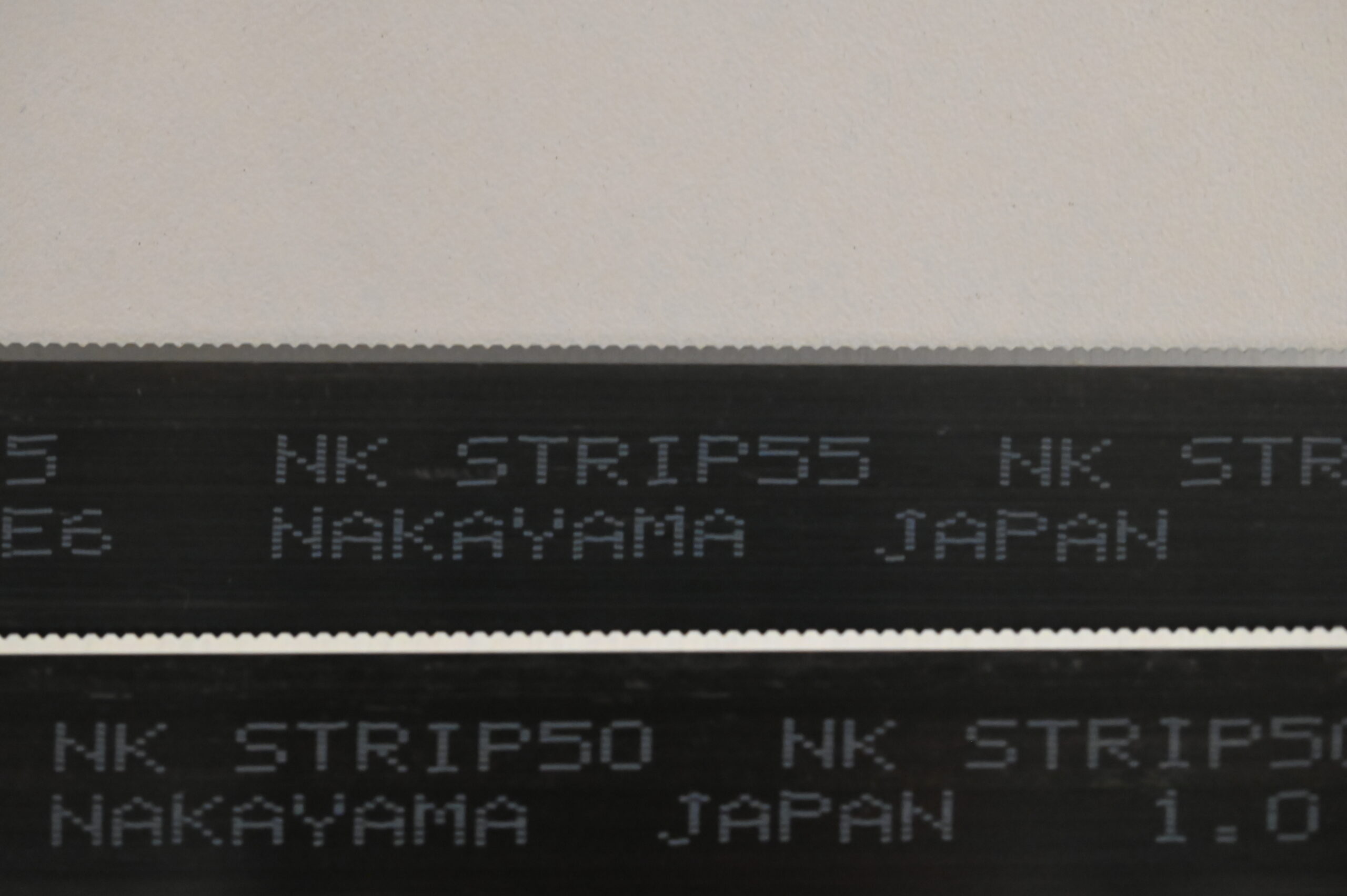
Nakayama, listening closely to feedback from the field, has developed a new stripper rule called "NK STRIP," featuring a micro-textured surface at its tip.
While the base shape follows the standard stripping rule edge profile, the addition of a fine, uneven texture at the tip achieves a contact behavior never seen before.
■ NK STRIP Design Points
● A unique shape featuring fine micro-texturing at the tip
● The base shape follows conventional stripping rule profiles, maintaining ease of integration into existing dies
● Can be introduced into existing stripping processes and equipment without major modifications
From "Surface Contact" to "Point Contact"
The greatest feature of NK STRIP lies in its contact mechanism.
Conventional strippers make contact with the scrap material across a flat "surface" (a wide area). This causes contact pressure to disperse, making it difficult—especially in conditions without a lower pin—to generate sufficient force to reliably push out the scrap.
NK STRIP's textured tip is designed so that contact with the scrap occurs at discrete "points" (localized contact).
● Contact pressure becomes concentrated at specific points
● The peeling force acts more clearly and directionally
As a result, stable stripping performance is achieved even in dynamic stripping without the use of a lower pin.
Implementation Effects
■ Resolves Scrap Residue, Contributing to Improved Uptime
● The adoption of "NK STRIP" significantly reduces scrap residue—a persistent challenge with conventional strippers
● Improved stripping accuracy also helps reduce processing defects
● Fewer micro-stoppages (brief, minor stops) = fewer instances of machine downtime
● Greater equipment operational stability, leading to increased production uptime
● Achieves both efficiency and stability throughout the entire punching process
■ Unlocking the True Efficiency of Dynamic Stripping
Enjoy the setup-time reduction benefits of eliminating lower pins—without paying the traditional price of scrap residue or demolding defects.
NK STRIP is being proposed to manufacturing sites as a new standard, delivering the "final push" needed to accelerate the widespread adoption of dynamic stripping.